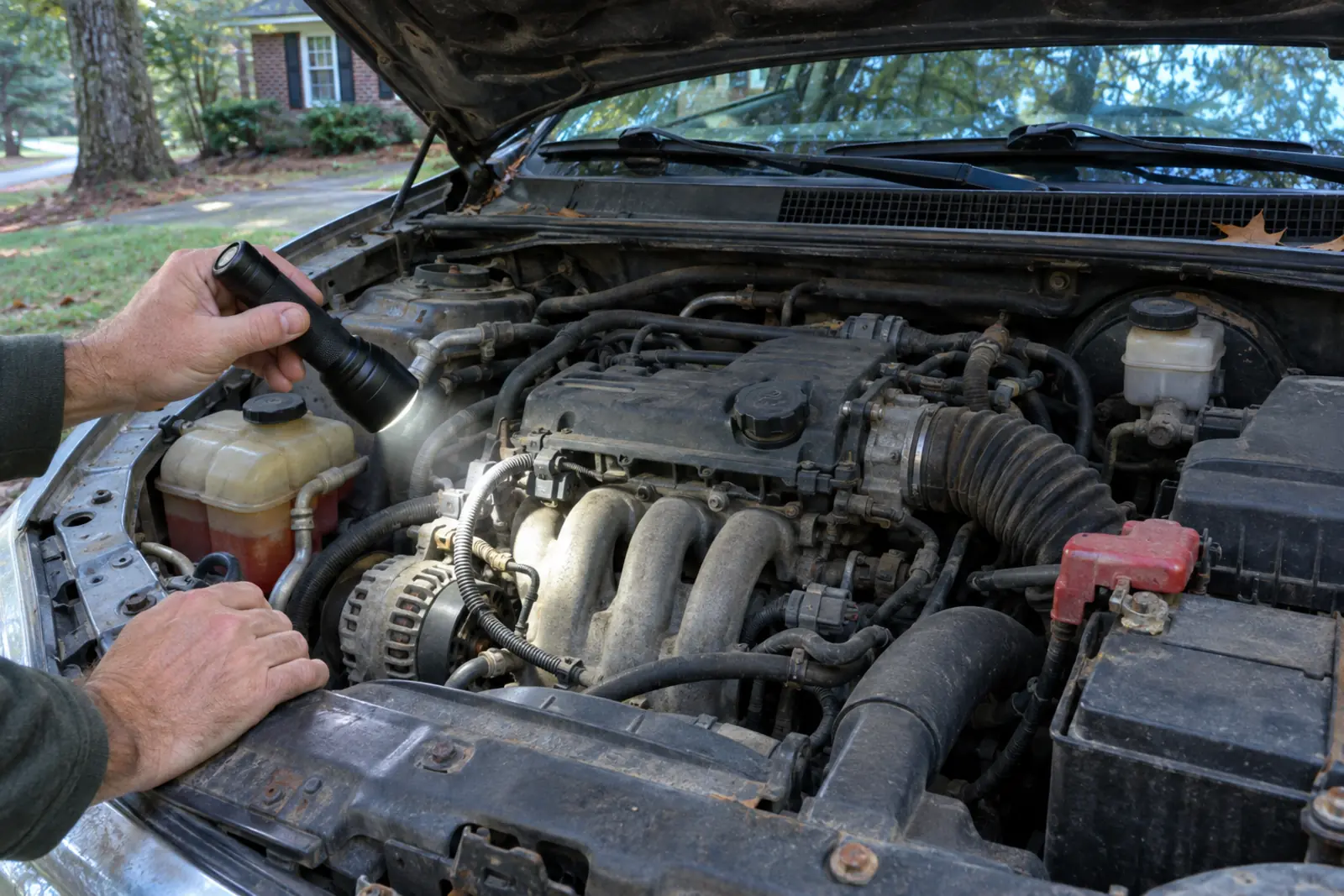
Before you buy a used car, check it in daylight with the engine cold: look over the body and tires, check under the hood and under the car for leaks, test every electrical feature and the air conditioning, take a test drive on varied roads, and confirm the VIN matches the paperwork. Then have an independent mechanic do a pre-purchase inspection. Your own checklist screens out obvious problems; the mechanic finds the ones you cannot see. Use the lists below on your first visit and bring a flashlight, a paper towel and a friend if you can.
Before you go
- Run the VIN through free history and recall tools; see how to check a used car's history with the VIN.
- Ask the seller not to start the car before you arrive. A cold start reveals noises, smoke and hard starting that a warm engine can hide.
- Plan to view the car in daylight and dry weather. Rain hides paint flaws and leaks.
- Bring a flashlight, paper towels, a small magnet if you have one, and your phone for photos.
Exterior walk-around
| Check | What to look for | Why it matters |
|---|---|---|
| Panel gaps | Uneven gaps between doors, hood, trunk and fenders | Possible accident repair |
| Paint | Color mismatch between panels, overspray on rubber trim | Body work that may not appear in a history report |
| Glass | Chips, cracks, mismatched brand markings | Replacement glass may point to an accident |
| Tires | Tread depth, uneven wear, different brands, the date code on the sidewall | Uneven wear suggests alignment or suspension problems |
| Rust | Bubbling paint on wheel arches, rocker panels and door bottoms | Hidden rust spreads and is expensive to fix |
| Lights | Fogged or cracked lenses; moisture inside | Safety and replacement cost |
Under the hood
- Oil. Pull the dipstick. Very dark, gritty or milky oil is a warning sign. Milky residue under the oil cap can mean a head gasket problem.
- Coolant. Check the level in the reservoir with the engine cold. Never open a hot radiator cap.
- Belts and hoses. Look for cracks, fraying or soft, swollen hoses.
- Battery. Check the date and look for corrosion on the terminals. Heat is hard on batteries, which matters in an Alabama summer.
- Leaks. Look for wet spots on the engine and on the ground beneath it.
- Signs of a recent clean. A spotless engine on an older car can be innocent, or it can be hiding leaks.
Interior
- Turn the key to "on" without starting. Warning lights should come on and then go off once the engine starts. A light that never comes on may have been disabled.
- Test every window, lock, mirror, seat adjustment, the radio, the screen, the USB ports and the horn.
- Run the air conditioning on maximum for several minutes. It should blow cold quickly. Then test the heat.
- Compare wear on the pedals, steering wheel and driver's seat with the odometer reading. Heavy wear on a low-mileage car is suspicious.
- Smell the cabin. A musty or moldy odor, or heavy air freshener, can signal water damage.
Flood damage warning signs
Cars damaged by hurricanes and floods along the Gulf Coast and elsewhere can end up for sale far inland, sometimes after a title has been "washed" through another state. Look for:
- Silt, sand or a water line under the carpets, in the trunk under the spare tire, or inside the door panels.
- Rust on seat rails, screws and brackets under the dash, where it should not be on a newer car.
- Fogging inside the headlights or gauges.
- Electrical faults that come and go.
- New carpet in an otherwise worn interior.
A free NICB VINCheck and a title check through the National Motor Vehicle Title Information System can show flood or salvage records, though not every damaged car is reported.
Test drive
- Start the engine and listen for knocks, ticks or squeals. Watch the exhaust for blue or white smoke.
- Drive slowly over bumps and listen for clunks from the suspension.
- Accelerate firmly onto a highway, such as the stretch of AL-77 toward I-20 if you are near Talladega. Shifts should be smooth, without slipping or flaring revs.
- At highway speed, check for vibration, wandering and wind noise.
- Brake firmly in a safe place. The car should stop straight without pulsing or grinding.
- Turn the wheel fully in each direction in a parking lot and listen for clicks or groans.
- After the drive, look under the car again for fresh drips.
Paperwork check
- The VIN on the dashboard, the driver's door jamb and the title or dealer paperwork should match.
- On a dealer lot, read the Buyers Guide on the window. It states whether the car is sold as-is.
- Ask for service records and the number of previous owners.
- In a private sale, the name on the title should match the seller's ID. See buying or selling a car privately in Alabama.
The professional pre-purchase inspection
A mechanic can put the car on a lift, read stored trouble codes with a scan tool, measure brake and tire wear, check for frame damage and evaluate the transmission and suspension. The Federal Trade Commission encourages buyers to get an independent inspection even when buying from a dealer. Prices vary by shop and by how thorough the inspection is, commonly in the low hundreds of dollars; ask for a quote. If the seller will not allow an inspection, treat that as a reason to walk away. If the car is sold as-is, the inspection matters even more; see used car warranties and as-is sales in Alabama.
Frequently Asked Questions
What is the most important thing to check on a used car?
There is no single item, but a cold start, a varied test drive and an independent mechanic's inspection together catch most serious problems. The vehicle history check comes first.
How can I tell if a used car was in a flood?
Look for silt or a water line under carpets and in the trunk, unexpected rust under the dash, musty odors and electrical faults, and run the VIN through NICB VINCheck and an NMVTIS title check.
Should I get a pre-purchase inspection on a cheap car?
Yes. A low price makes a hidden repair proportionally more painful. An inspection costs far less than an engine or transmission problem you did not know about.
Can a dealer refuse an independent inspection?
A seller can refuse, but you can also walk away. The FTC encourages buyers to have a used car inspected by a mechanic they choose.
What should a test drive include?
A cold start, slow driving over bumps, highway acceleration and cruising, firm braking, full-lock turns, and a final look under the car for leaks.