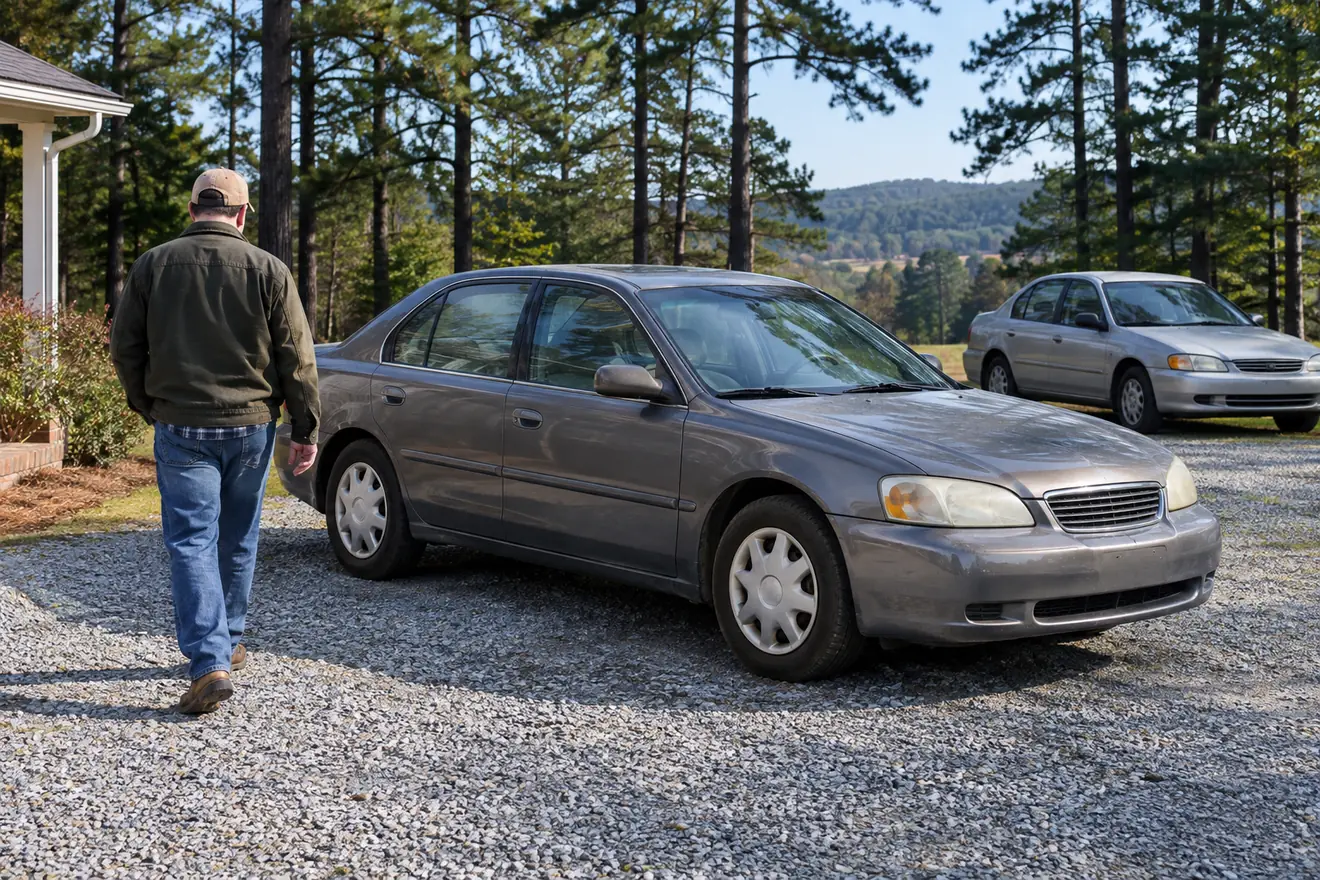
The safest way to buy a used car in Alabama is to set a total budget first, arrange financing before you shop, check the vehicle's history and condition independently, negotiate the out-the-door price in writing, and then title and register the car with your county within 20 calendar days of the purchase. Each step protects you from a different kind of mistake, and skipping one is how most bad deals happen. Alabama has no cooling-off period on vehicle sales, so the work you do before you sign is your main protection. This guide walks through the process in order, with notes for buyers in Talladega and the rest of Talladega County.
Step 1: Decide what you can actually afford
Start with the full cost of owning the car, not the sticker price or the monthly payment. A realistic budget includes:
- The purchase price, plus Alabama sales tax and any applicable local tax, title and registration costs.
- Insurance, which can vary widely by vehicle, driver age and coverage level.
- Fuel, which matters a great deal if you commute toward Birmingham, Anniston or Sylacauga. The guide to calculating a car's fuel cost before you buy shows how to compare models on a real-world commute.
- Routine maintenance and a repair reserve. Older, higher-mileage cars need a bigger cushion.
- The annual ad valorem (property) tax that Alabama collects with your registration renewal.
The tax and fee side is covered in detail in the guide to Alabama car sales tax, title and tag fees. If you plan to borrow, work out the loan cost with the method in how to calculate a car payment and total loan cost before you visit a lot.
Step 2: Line up financing before you shop
A pre-approval from a bank or credit union tells you the interest rate and the maximum amount you can borrow. The Federal Trade Commission recommends getting pre-approved and comparing any dealer offer against it on the APR, the loan length and the amount financed. With a pre-approval in hand, you are negotiating the price of the car, not a monthly payment that can hide extra costs. Buyers with damaged credit have more steps to take; see the guide to getting a used car loan with bad credit.
Step 3: Choose where to buy
| Source | Advantages | Watch out for |
|---|---|---|
| Franchise dealer (used inventory) | Larger selection, certified pre-owned options, financing on site | Add-on products, dealer fees, higher asking prices |
| Independent used car dealer | Older and lower-priced vehicles, flexible negotiation | Many sales are as-is; condition varies widely |
| Buy here pay here lot | Approval with poor or thin credit | High interest, strict payment terms, tracking devices |
| Private seller | Often the lowest price, no dealer fees | No Buyers Guide, no warranty, title problems are your risk |
| Online retailer | Convenient, return windows at some sellers | Out-of-state paperwork, limited chance to inspect first |
Dealers that sell more than five used vehicles a year must post the FTC Buyers Guide on each car. The Buyers Guide states whether the car comes with a warranty or is sold as-is. When a car is sold as-is, the dealer bears no cost for any problem that appears after the sale — a point the Alabama Attorney General's Consumer Protection office specifically flags as a risk for used car buyers. Private sellers are not required to post a Buyers Guide. The trade-offs of private sales are covered in buying or selling a car privately in Alabama; the specific pros, cons and questions to ask at buy-here-pay-here lots are in buy here pay here in Alabama. For what an as-is sale means legally and what service contracts actually cover, see used car warranties, as-is sales and service contracts in Alabama.
Alabama sets no state cap on dealer documentation fees. This line item can run several hundred dollars or more and is a legitimate negotiating point. Ask for the amount before you spend time on a vehicle.
Step 4: Shortlist and compare vehicles
Pick two or three models that fit your needs rather than falling for a single car. For each one, look at reliability records, typical repair costs, fuel economy and insurance cost. Compare similar listings by year, mileage and trim so you know what a fair asking price looks like in the area. Pricing guides such as Kelley Blue Book and Edmunds give a starting range, but local supply matters too.
Step 5: Check the history and the condition
Before you get attached to a car, run its 17-character VIN through the free tools that exist for this purpose: the NHTSA recall lookup, a title check through the National Motor Vehicle Title Information System, and the free NICB VINCheck for theft and total-loss records. The guide to checking a used car's history with the VIN explains what each one shows.
Then inspect the car yourself and pay an independent mechanic for a pre-purchase inspection. The FTC encourages buyers to do this even on dealer lots. A seller who refuses to let a mechanic look at the car is giving you useful information. Use the used car inspection checklist on your first visit.
Step 6: Test drive with a plan
- Start the engine cold if you can. Some problems disappear once the engine is warm.
- Drive on a mix of roads: slow neighborhood streets, a rough patch, and a stretch at highway speed.
- Check the brakes, steering pull, transmission shifts and any warning lights.
- Run the air conditioning on full. In an Alabama summer, a weak AC system is a real cost.
- Listen with the radio off.
Step 7: Negotiate the out-the-door price
Ask for the out-the-door price in writing: the vehicle price plus every fee, tax and add-on. Negotiate that number, not the monthly payment. Settle the price of the car before you discuss a trade-in, then negotiate the trade-in separately; how to get a fair trade-in value explains why. Read the list of add-ons carefully. Service contracts, GAP coverage, etching and similar products are optional, and the FTC notes that you can decline them. Because Alabama sets no cap on documentation fees, verify that line item before you agree to the final price.
Step 8: Read everything before you sign
- Confirm that the price, APR, term and down payment on the contract match what you agreed.
- Check that the financing is final, not "pending approval."
- Compare the VIN on the contract, the title paperwork and the car itself.
- Read the Buyers Guide. Its terms become part of the sales contract.
- Get signed copies of every document you sign.
- Confirm that the seller has completed the odometer disclosure section of the title — federal law requires it at the time of transfer.
Federal law does not require dealers to offer a return window, and Alabama has no state cooling-off or rescission period for vehicle purchases. Once the contract is signed, the deal is done.
What Alabama law does and does not cover
Alabama's lemon law covers only new vehicles purchased from a dealer within 12 months or 12,000 miles of the original sale. According to the Alabama Attorney General's Consumer Protection office, used car buyers have no lemon law protection — which makes the inspection and test drive in steps 5 and 6 your primary safeguard against buying a problem vehicle.
If a dealer misrepresents the condition of a car, fails to disclose a branded title (salvage, rebuilt or flood), or uses deceptive sales practices, the Alabama Deceptive Trade Practices Act (Code § 8-19) may allow a court to award up to three times the buyer's actual damages plus attorney fees. Buyers generally have one year from the date they discover the problem to file a claim. Get every promise in writing before you sign — oral promises are difficult to enforce even in fraud cases.
Step 9: Insure, title and register
Alabama requires liability insurance before a vehicle can be registered. The Alabama Department of Revenue sets the minimum at $25,000 for bodily injury per person, $50,000 for all injuries in a single accident, and $25,000 for property damage. Full coverage rules are in Alabama car insurance requirements for new owners.
Once insured, you have 20 calendar days from the purchase date to register the vehicle. Missing that deadline triggers a late fee under Alabama law. Dealers typically handle the title application; in a private sale, you bring the signed title to the county office yourself. If the car was previously titled in another state, the county requires a VIN inspection before Alabama will issue a new title — a governmental law enforcement officer completes Form MVT 5-10 to verify the VIN matches the out-of-state documentation. The full process for local buyers is set out in how to title and register a car in Talladega County.
Frequently Asked Questions
How long do I have to register a used car after buying it in Alabama?
The Alabama Department of Revenue gives owners 20 calendar days from the date of purchase or acquisition to register without penalty. Missing the deadline triggers a late fee. Counting starts the day after the purchase.
Does Alabama's lemon law protect used car buyers?
No. Alabama's lemon law applies only to new vehicles purchased from a dealer within 12 months or 12,000 miles of the original sale, whichever comes first. According to the Alabama Attorney General's Consumer Protection office, used car buyers have no lemon law protection. A thorough pre-purchase inspection by an independent mechanic and a written as-is or warranty disclosure in the Buyers Guide are the buyer's main protections.
Is there a cooling-off period if I change my mind after buying?
No. Federal law does not require dealers to offer a return window, and Alabama has no state rescission period for vehicle sales. Once the contract is signed, the deal is final. The only exceptions are specific written return or exchange policies a dealer voluntarily offers.
Do I need a pre-purchase inspection if the dealer already inspected the car?
It is still a good idea. A dealer inspection is done for the seller. An independent mechanic works for you and can spot problems that affect the price or your decision to buy.
Should I tell the dealer about my trade-in right away?
The FTC suggests negotiating the price of the car first and the trade-in separately. Mixing them makes it harder to judge each deal on its own.