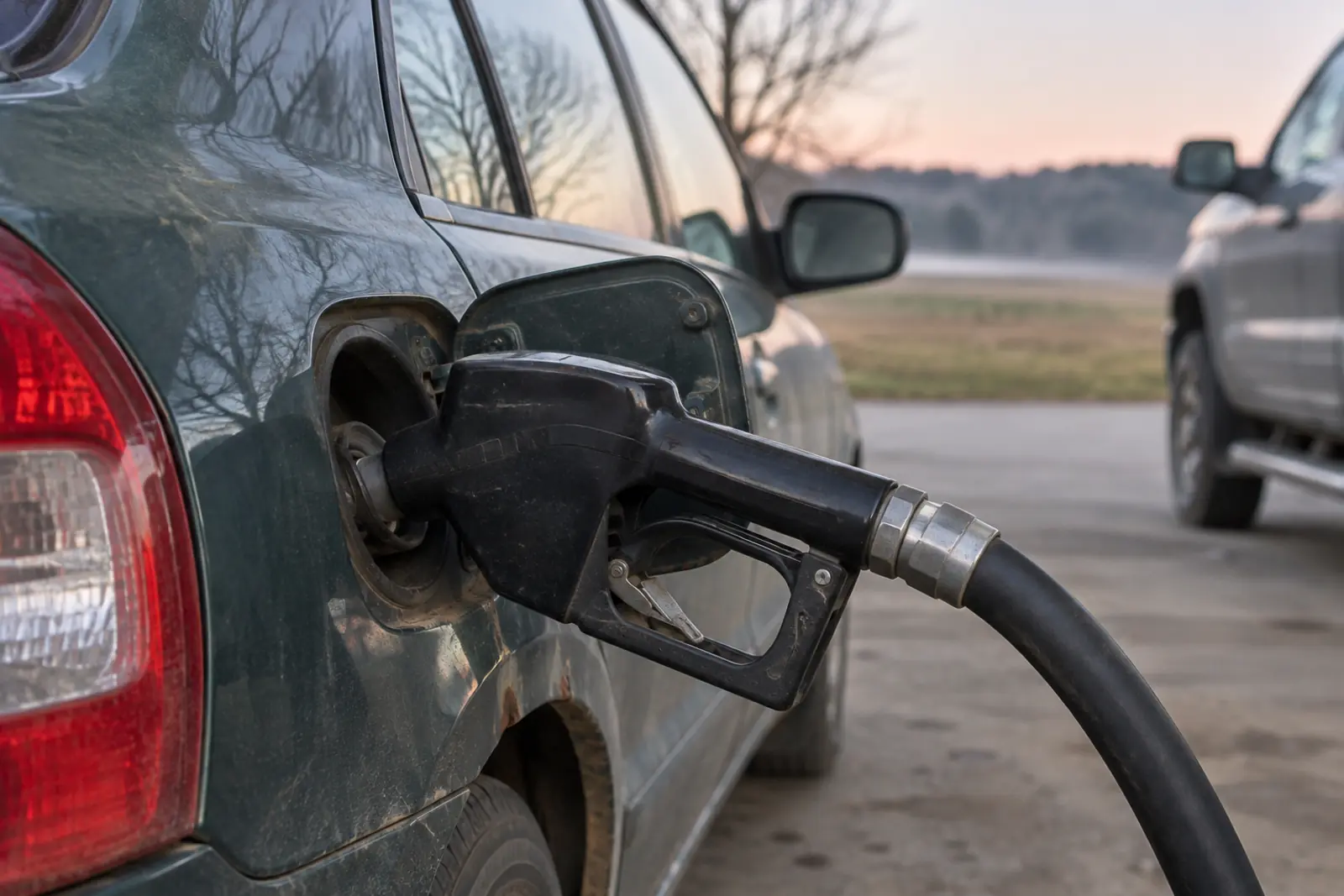
To calculate the fuel cost of a car, divide the miles you drive in a year by the car's combined miles-per-gallon rating, then multiply by the price of a gallon of fuel. At 15,000 miles a year and $3.00 a gallon, a car that averages 20 mpg uses about $2,250 of fuel, while one that averages 30 mpg uses about $1,500. That $750 yearly gap belongs in your budget next to the loan payment and insurance. For drivers in Talladega who commute toward Birmingham, roughly 50 miles away, the mileage and the gap can be much larger.
How to calculate the annual fuel cost of a car
Annual fuel cost = (annual miles / mpg) x price per gallon.
Use the EPA's combined mpg rating for each vehicle, which you can look up on fueleconomy.gov, the official US government fuel economy site run by the Department of Energy and the EPA. It covers used models going back decades and lets you compare vehicles side by side. Your real results will differ with driving style, terrain, weather, tire pressure, the vehicle's condition and how much highway driving you do.
The combined rating blends 55 percent city and 45 percent highway driving, per the EPA methodology. If you drive mostly open highway, your real mileage may edge above that figure. Heavy stop-and-go traffic or frequent short cold starts typically pulls it lower.
Cost per mile
To find fuel cost per mile, divide the price per gallon by the vehicle's mpg. At $3.50 a gallon and 25 mpg, that is $0.14 per mile. Multiply by any trip distance to find its exact fuel cost. Cost per mile is also the right unit when comparing a gasoline car with an electric vehicle, since EVs are measured in kilowatt-hours per mile rather than gallons.
Example: 15,000 miles a year
The fuel price below is an example only. Use the current local price when you run your own numbers. Alabama regular-grade gasoline averaged about $3.55 per gallon in November 2026, according to AAA.
| Combined mpg | Gallons a year | Annual cost at $3.00 | Monthly cost |
|---|---|---|---|
| 15 mpg | 1,000 | $3,000 | $250 |
| 20 mpg | 750 | $2,250 | $188 |
| 25 mpg | 600 | $1,800 | $150 |
| 30 mpg | 500 | $1,500 | $125 |
| 40 mpg | 375 | $1,125 | $94 |
| 50 mpg | 300 | $900 | $75 |
Notice that the savings shrink as mpg rises. Going from 15 to 20 mpg saves $750 a year at these figures; going from 40 to 50 saves $225. That is why a modest improvement on a thirsty truck or SUV can matter more than a jump between two already efficient cars.
Estimate your own mileage
- Write down your regular weekly trips: work, school, shopping, church, family visits.
- Measure each round trip with a map app.
- Multiply by the number of weeks you drive them, usually 50 for work.
- Add occasional long trips and a margin for errands.
A Talladega resident who drives to Birmingham and back five days a week covers roughly 100 miles a day, or about 25,000 miles a year from commuting alone. At $3.50 a gallon, that is about $4,375 a year in a 20 mpg vehicle and about $2,917 in a 30 mpg vehicle — a gap of roughly $1,460 each year. Shorter commutes to Anniston, Oxford or Sylacauga add up too. Long highway miles also wear tires and brakes and reduce resale value, so they affect more than fuel.
Fuel cost over the life of a loan
If you plan to keep a car for five years, multiply the annual difference by five. A $750 yearly gap becomes $3,750, which can be more than the price difference between two otherwise similar used cars. When comparing vehicles, add five years of fuel to the out-the-door price of each one, then compare. The guide to calculating a car payment and total loan cost shows how to work out the loan side of that comparison.
What lowers your real-world mpg
- Air conditioning. Long, hot Alabama summers mean heavy AC use, which costs some fuel economy, especially on short trips.
- Short trips. A cold engine is less efficient. Many short hops can pull your average well below the rating.
- Tire pressure. Underinflated tires increase rolling resistance. Check monthly with the pressure listed on the driver's door jamb.
- Speed. Fuel economy usually drops at higher highway speeds.
- Extra weight and roof racks. Cargo and racks add weight and drag.
- Maintenance. Worn spark plugs, dragging brakes and the wrong oil can all reduce fuel economy on a used car. A pre-purchase inspection can catch those problems before they become yours; see the used car inspection checklist for what to look for.
Comparing gas, hybrid and electric fuel costs
| Type | Fuel cost | Other costs to weigh |
|---|---|---|
| Gasoline | Depends on mpg and price | Familiar maintenance; widest choice of used models |
| Hybrid | Often much lower in mixed and city driving | Hybrid battery age on older models; check any remaining warranty |
| Plug-in hybrid | Very low if you charge regularly and drive short distances | Home charging setup; Alabama's additional annual registration fee |
| Battery electric | Electricity cost per mile is usually lower than gasoline | Battery health on used models, charging access, Alabama's additional annual registration fee |
For electric vehicles, fueleconomy.gov includes EVs in its side-by-side comparison tool, so you can compare a specific model against a gasoline alternative directly. Home charging is typically far cheaper per kilowatt-hour than public fast-charging stations, which can narrow the fuel-cost advantage on longer trips away from home.
Alabama charges an additional annual registration fee on battery electric and plug-in hybrid vehicles under Code of Alabama 40-12-242. The fee is currently $203 per year for a battery electric vehicle and $103 per year for a plug-in hybrid; both amounts increase by $3 every four years starting in 2023, according to the Alternative Fuels Data Center. Include it in your comparison along with the registration costs covered in Alabama car sales tax, title and tag fees.
How to use this when shopping
- Shortlist vehicles, then look up each one's combined mpg on fueleconomy.gov.
- Calculate the annual fuel cost for your real mileage.
- Add five years of fuel to each vehicle's out-the-door price.
- For used hybrids or EVs, pull a vehicle history report to check for accidents and service gaps that can affect battery and fuel systems; see how to check a car's history with the VIN.
- Check insurance quotes too; see Alabama car insurance requirements for new owners.
- Then follow the full process in how to buy a used car in Alabama.
Frequently Asked Questions
How do I calculate how much gas a car will cost per year?
Divide your annual miles by the car's combined mpg to get gallons used, then multiply by the price per gallon. For example, 15,000 miles at 25 mpg and $3.50 a gallon is about $2,100. Use the combined mpg from fueleconomy.gov and the current local pump price.
Where can I find the official mpg for a used car?
The EPA ratings for new and used models are on fueleconomy.gov, the official government site run by the Department of Energy and the EPA. The side-by-side comparison tool lets you put two vehicles next to each other and shows estimated annual fuel cost based on 15,000 miles.
Why is my real mpg lower than the EPA rating?
Short trips, heavy air conditioning use, high speeds, low tire pressure, extra weight and the vehicle's condition can all reduce real-world fuel economy. The EPA combined rating is a useful benchmark for comparison, but your actual result will vary.
How much does one mile per gallon improvement save per year?
It depends on your starting point. At 15,000 miles and $3.50 a gallon, going from 20 to 21 mpg saves about $125 a year; going from 30 to 31 mpg saves about $56. The lower your starting mpg, the more each additional mpg is worth — which is why replacing a 15-mpg vehicle with a 20-mpg one saves far more in fuel than the same 5-mpg jump at the efficient end of the range.
Is a hybrid worth it for a long commute?
It can be, especially with a lot of mixed driving. Compare the extra purchase price with several years of fuel savings, and check the condition of the hybrid battery on older models.
Does Alabama charge extra to register an electric car?
Yes. Under Code of Alabama 40-12-242, Alabama adds an annual fee of $203 for battery electric vehicles and $103 for plug-in hybrids, on top of standard registration costs. Both amounts increase by $3 every four years starting in 2023, so confirm the current figure with the Alabama Department of Revenue before you buy.